What Is Web of Trust?
Web of Trust replaces centralized gatekeepers with something more natural: the trust you already place in the people you know. Here's how it works and why it matters for Nostr.

Leon Acosta
Trust is the foundation of every online interaction. When you read a post, follow an account, or share content, you're making a judgment about who deserves your attention. But how do you make that judgment at scale, without a company deciding for you?
That's the question Web of Trust answers.
Trust Without Gatekeepers
In most platforms, trust is centralized. A company verifies accounts, curates feeds, and decides who gets banned. It works — until it doesn't. Censorship, bias, and opaque algorithms erode the very trust they claim to provide.
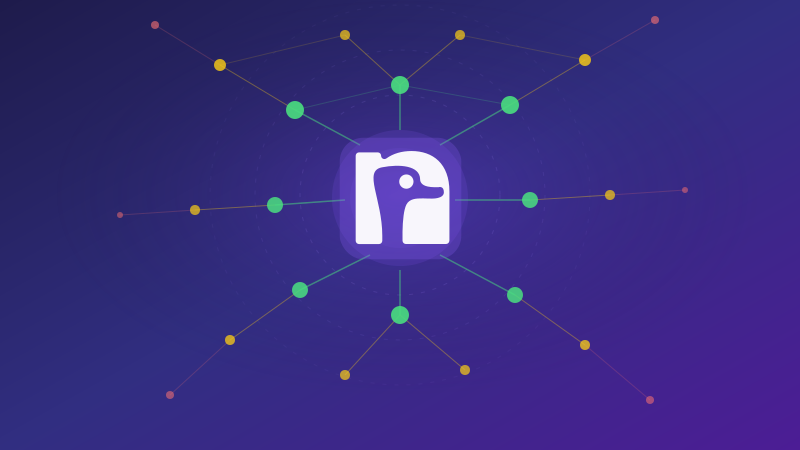
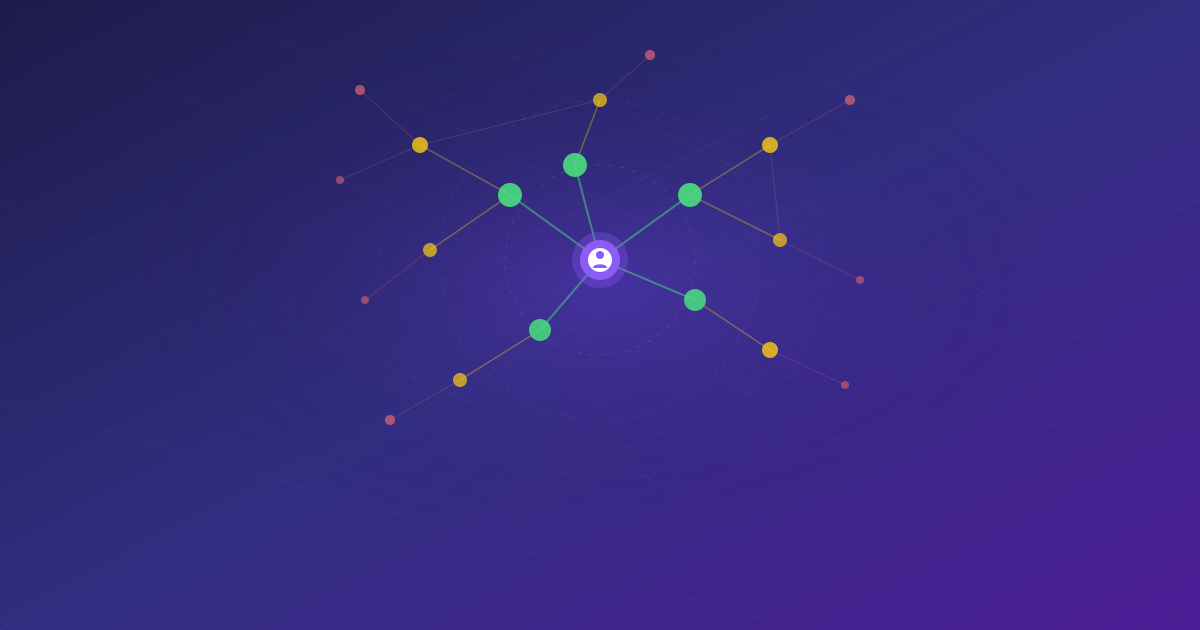
Web of Trust flips this model. Instead of a central authority, you are the root of your own trust network. The people you follow are your first circle of trust. The people they follow form your second circle. And so on.
Think of it like real life. You trust your friends. You somewhat trust your friends' friends. A stranger five handshakes away? You'd probably want some proof before trusting them.
How It Works
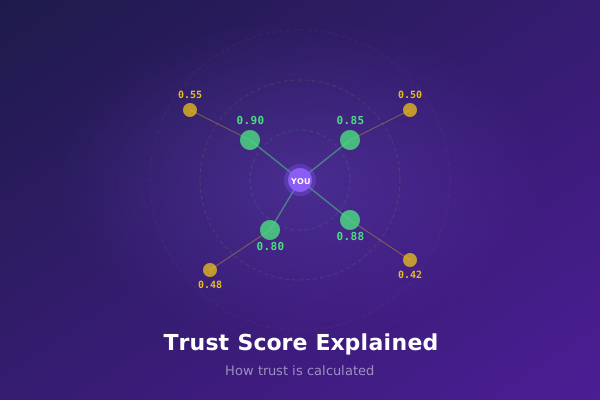
Web of Trust maps your social connections into a directed graph with measurable trust levels:
- 1 hop — People you follow directly. Highest trust.
- 2 hops — Friends of friends. Moderate trust.
- 3 hops — Two degrees removed. Lower trust.
- Beyond 3 hops — Essentially unknown to your network.
Each hop reduces the trust score. But it's not just about distance — the number of paths matters too. If five of your trusted contacts all follow the same person, that person has more credibility than someone reached through a single chain.
The Origin of the Idea
Web of Trust isn't new. Phil Zimmermann introduced the concept in 1991 with PGP (Pretty Good Privacy), a system for encrypting email. In PGP's Web of Trust, users signed each other's public keys to vouch for their identity. If you trusted Alice, and Alice signed Bob's key, you could reasonably trust Bob too.
The idea was revolutionary: trust doesn't need a certificate authority. It can emerge from relationships.
Nostr brings this concept into social networking. Instead of signing cryptographic keys, trust flows through follow relationships — a natural, low-friction signal that already exists in the protocol.
Why Nostr Needs It
Nostr is an open protocol. Anyone can publish. No one can be banned at the protocol level. This is its greatest strength and its biggest challenge.
Without any filtering:
- Bots can flood relays with spam
- Impersonators can copy anyone's identity
- Low-quality content competes equally with valuable posts
Centralized solutions (blocklists, admin moderation) contradict Nostr's principles. Web of Trust provides a decentralized alternative — each user's trust network acts as a personalized, self-sovereign filter.
Web of Trust in Practice
With Nostr Web of Trust, your browser extension builds a local graph of your social connections. Any Nostr app can then query this graph to answer questions like:
- Is this person in my network? Filter out complete strangers.
- How far away are they? Prioritize closer connections.
- What's their trust score? Make nuanced decisions.
// Check if a pubkey is in your Web of Trust
const trusted = await window.nostr.wot.isInMyWoT(pubkey);

// Get the distance in hops
const distance = await window.nostr.wot.getDistance(pubkey);

// Get a normalized trust score (0 to 1)
const score = await window.nostr.wot.getTrustScore(pubkey);
The result: your feed reflects your trust judgments, not an algorithm's.
Privacy by Design
A trust system that tracks your social graph could be a privacy nightmare. That's why we built three modes:
- Local Mode — Your graph stays entirely in your browser. No server ever sees it.
- Remote Mode — Queries go to our oracle server, but only pubkeys are sent. No content, no metadata.
- Hybrid Mode — Cached locally with remote fallback for unknown keys.
You choose your trade-off between performance and privacy.
Beyond Filtering
Web of Trust isn't just about blocking spam. It opens up possibilities like:
- Reputation systems — Weight content by the author's trust score
- Discovery — Find valuable accounts through trusted paths
- Collaborative moderation — Communities can define shared trust boundaries
- Relay selection — Prefer relays used by trusted contacts
The deeper your trust graph, the more useful it becomes.
Try It Yourself
Ready to see your trust network in action? Download the extension to start filtering with Web of Trust, or explore your connections visually in the Playground.
Questions? Reach out on Nostr or check our documentation.